It would be easy to argue for incumbent banks, with their scale, licenses, customer trust and infrastructure. Just as easy to back fintech challengers, with their speed and freedom from legacy constraints. Others would point to processors, which sit closest to the transaction, or Big Tech, which increasingly controls the AI layer itself.
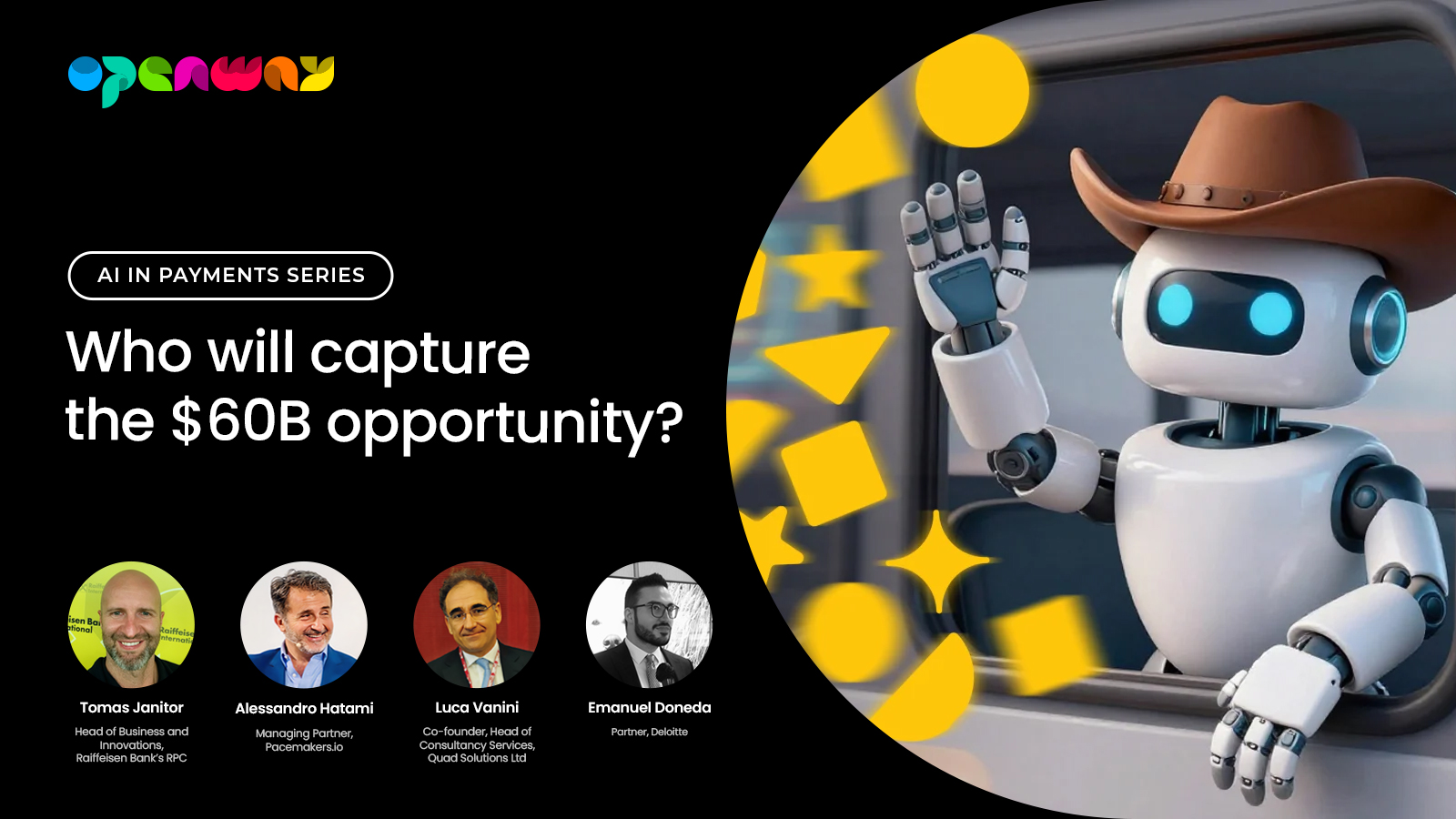
We put this question to Tomas Janitor, Head of Business and Innovations at Raiffeisen Bank’s RPC; Alessandro Hatami, Managing Partner at Pacemakers.io; Luca Vanini, Co-founder and Head of Consultancy Services at Quad Solutions Ltd; and Emanuel Doneda, Partner at Deloitte, at Il Salone dei Pagamenti. What stood out was not only the variety of answers. It was the fact that each of them approached the opportunity from a different angle.
Different answers, one shared insight
One view favored ambitious startups. The reasoning was straightforward: AI is still new territory, and startups are structurally freer to pursue it. They are not weighed down by legacy systems or by the need to protect large, established businesses.
Another view was more cautious. It may simply be too early to say where the value will settle. It could go to platforms, model providers, banks, processors, or even the businesses that apply AI most effectively.
A third perspective pointed to large fintechs and processors already improving areas such as checkout and agentic payments, while smaller banks may benefit from AI-enabled systems that are quicker and cheaper to deploy than traditional ones. Big banks, meanwhile, often appear to be using AI more to accelerate internal development than to reshape customer propositions.
And then came perhaps the most important observation of all: in the end, it may matter less whether an institution is a bank, a fintech or an incumbent processor than whether it can adopt AI in a way that is fast, secure and genuinely transformative.
Perhaps the real question that needs to be asked is different
That leads to a slightly contrarian conclusion: perhaps “who is best positioned?” is not the real question all along.
In previous waves of payments innovation, winners were often defined by distribution, customer ownership or regulatory access. AI is different. It is not simply another feature or channel. It has the potential to reshape how institutions build, operate, serve customers and make decisions.
The real dividing line may not be between banks, fintechs and Big Tech. It may be between organizations that treat AI as a side project and those that use it to change how they compete.
Execution will matter more than identity
What seems to unite all four answers is this: AI in payments will not be won by labels. It will be won by execution.
The institutions that capture the greatest value are likely to be the ones that move beyond pilots, embed AI into core operations, and become faster and smarter without becoming less secure or less trusted.
That is what makes this question so revealing. It sounds like a debate about market winners — but in reality, it is a debate about AI readiness.
Watch the video:
The series starts here
This is the first post in our AI in payments series from Il Salone. Over the next several posts, we will explore the questions financial institutions are now facing most urgently: whether AI should reduce cost or drive return, why so many projects fail to deliver impact, how success should be measured, how the industry may evolve over the next few years, what projects are delivering real lessons today, and what leaders see as the next step in their own AI journey.
The field is still open. And that may be the most important insight of all. Stay tuned for more.