Platform selection is usually treated as a technology decision. Buyers compare functionality, architecture, deployment models and roadmaps. Yet in practice, ROI is often determined by how well the platform is implemented, configured and evolved over time.
For OpenWay, the company behind the Way4 platform, years of delivering transformations for banks, processors and fintechs across regions and business models have led to one clear conclusion: long-term platform value is shaped as much by delivery discipline as by product capability. As Chief Technology Officer Dmitry Yatskaer puts it:

“You can have a powerful platform, but without disciplined execution, the results will always fall short.”
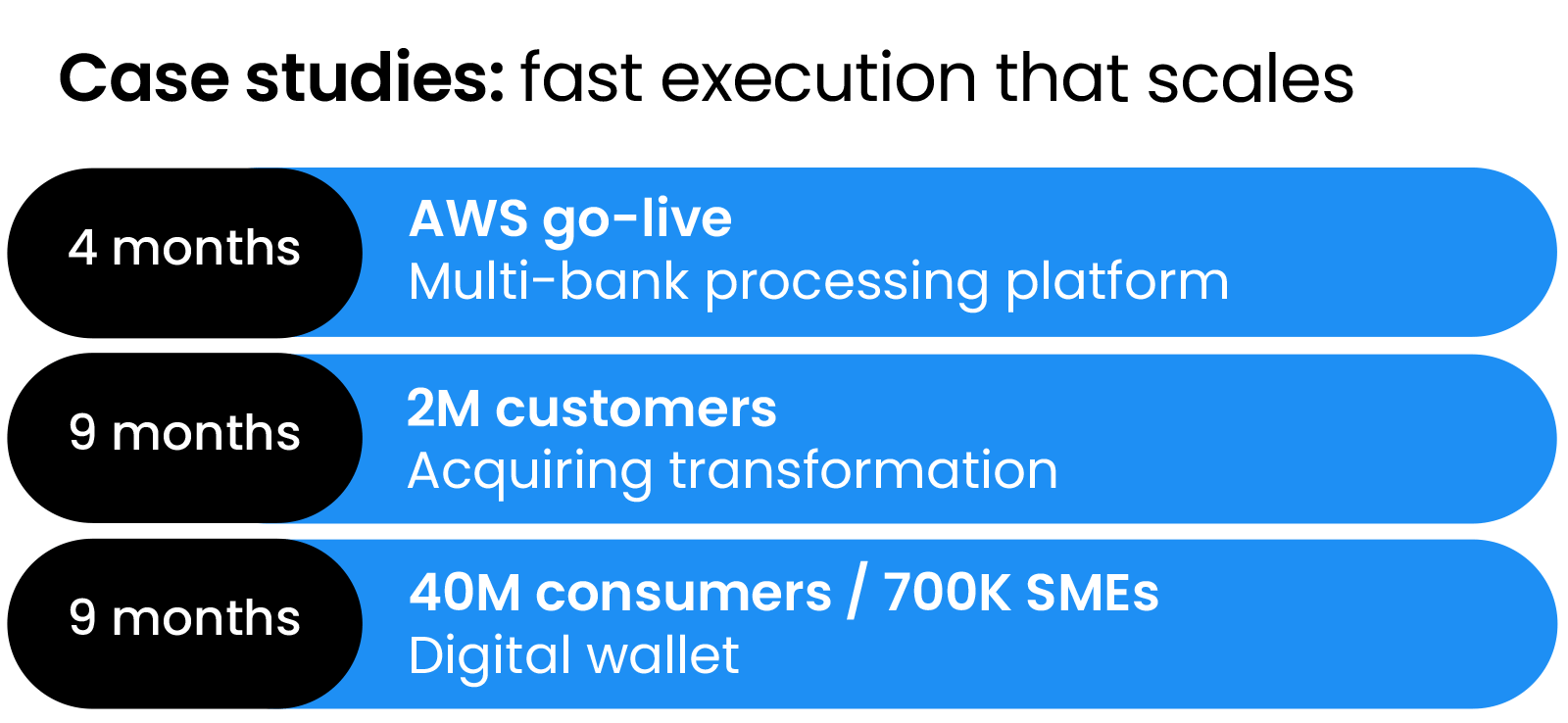
Its delivery experience makes the point clearly. In one large-scale acquiring transformation, the platform was delivered in 9 months for a processor whose acquiring base later grew to 2 million customers. In another case, a digital multi-bank processing platform went live on AWS in just 4 months. In a third, a wallet platform launched in 9 months and scaled to 40 million consumers and 700,000 SMEs in 3 years.
Payment businesses run in real time, support multiple products and channels, depend on complex integrations, and must preserve continuity while adapting to new commercial and regulatory demands.
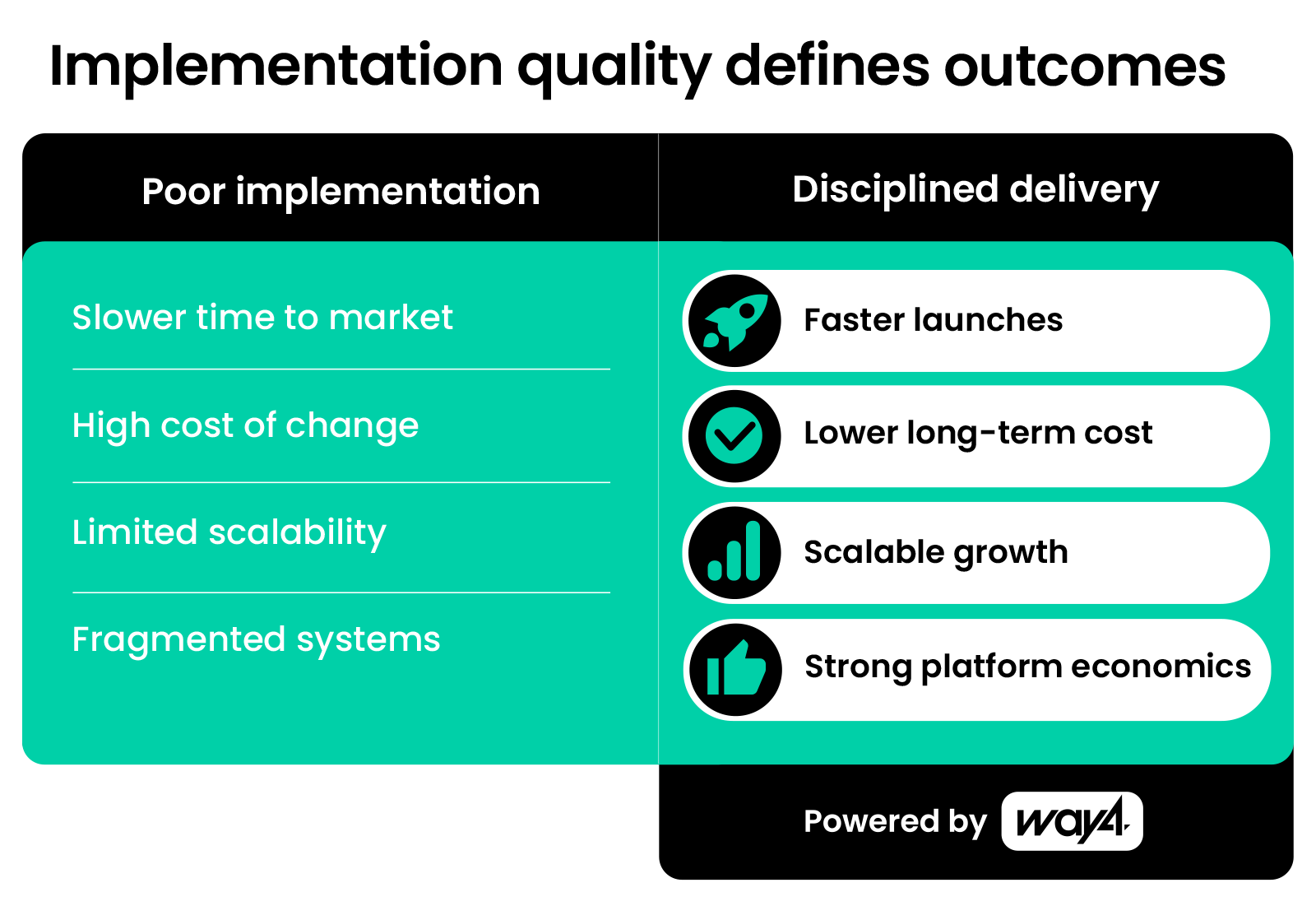
In that environment, poor implementation does not merely cause delays. It can slow time to market, inflate the cost of future change, limit scalability and constrain the business models an institution can support later. By contrast, disciplined delivery creates compounding value: faster launches, more efficient scaling, less disruption and stronger platform economics over time.
Implementation, therefore, should be seen not as a downstream project phase, but as a strategic capability.
Where ROI is really won — or lost
1. Discovery discipline sets the foundation for success
The discovery phase is where ROI is either protected or put at risk. It is not just about gathering requirements—it is about aligning business goals, technical realities, and ways of working, while establishing a shared vocabulary across stakeholders.
Clients are experts in their own business. Vendors are experts in their platforms and in how to deliver them effectively, holding different assumptions about priorities, dependencies or the degree of adaptation required. Those gaps usually emerge later, when they are more expensive to correct.
As Head of Delivery Denis Kvitka notes:

“The deeper issue is misinterpretation: delivery teams and clients may think they agree while actually meaning different things.”
2. Smart configuration protects future economics
In payments, early technical decisions have long-term financial consequences. Shortcuts during implementation—especially excessive customization—can significantly increase the total cost of ownership.
“If a vendor does some kind of custom coding,” Dmitry explains, “later all changes become too expensive, because the configuration was not done in a smart enough way.”
Poor choices at this stage can complicate upgrades, limits scalability, and slows innovation. By contrast, well-structured configuration enables flexibility, faster changes, and smoother expansion.
A disciplined approach may require more effort upfront, but it protects ROI over the platform lifecycle.
3. Continuity after go-live accelerates value creation
Implementation does not end at go-live. In most payment businesses, value is created over time through refinements, extensions, new launches and expansion. The efficiency of that next phase depends on whether delivery continuity is preserved.
Many organizations lose momentum here. Knowledge is fragmented, ownership shifts, and new teams must relearn decisions already made. Here, the model is different. The same delivery group remains responsible throughout the client lifecycle.
“At OpenWay, the same team who did the initial delivery remains in charge of customer success,” Dmitry says. “When a client has a variation, it doesn’t get allocated to a random team.”
Why this matters in platform selection
For banks, delivery quality shapes more than a project timeline. It affects how well the institution can modernize legacy environments, manage risk and launch new propositions. For processors and payment infrastructure players, it underpins scale, resilience and more efficient evolution. For fintechs, it enables speed without creating avoidable technical and operational debt.
For executives selecting a payment platform, the practical conclusion is straightforward: assess delivery capability with the same rigor as product capability. Buyers should examine how a vendor runs discovery, balances standardization with flexibility, approaches configuration versus custom development, preserves continuity after go-live, and supports future change at scale.
Selecting a payment platform is not just choosing a technology: it is also choosing a delivery organization. At OpenWay, implementation is treated as a core capability—and one of the strongest predictors of long-term success.
We share a practical checklist to validate a vendor’s ability to deliver long-term ROI — download it here and connect with OpenWay experts to continue the conversation!

Maria Vin is Head of Strategy at OpenWay, where her work covers payment technology strategy, business models, roadmap direction, and go-to-market initiatives across banks, processors, and fintechs. Her background spans product management, digital transformation, and strategy, with contributions over the years to payment innovations including early digital wallets, universal payment hubs, omni-channel payments, and payment SaaS models. Today, she focuses on AI-driven and other emerging propositions, as well as product, brand, and growth strategy.

OpenWay is the only best-in-class provider of digital payment software solutions for card issuing, digital wallets, merchant acquiring, BNPL, transaction switching, tokenization, and fleet payments, and the best cloud payment systems provider as rated by Gartner, Aite (Datos Insights), Ovum (Omdia), Juniper Research, and PayTech. Top-tier banks and processors, as well as ambitious fintech startups, have chosen OpenWay as their strategic partner. With its unique capabilities in card issuing, BNPL, merchant acquiring, transaction switching, digital wallets, and fleet payments, the Way4 software platform guarantees an unparalleled customer payment experience.