
In payments, the half-life of a good idea is shrinking. AI is accelerating how quickly institutions identify customer needs, analyze behavior, and develop propositions. But competitors have access to the same acceleration. The competitive question is shifting from who sees the opportunity to who can act on it first.
Take a successful bank, processor, or fintech with strong market knowledge. AI reveals demand for a new proposition, and the team builds a strong business case.
Then the idea meets the payment platform. Pricing and authorization changes enter an IT queue. Integrations and fragmented systems extend testing. While the team waits, a competitor launches and the window to capture value starts narrowing.
The player has the right strategy and people. Its technology operating model is the constraint.
The commercial value of an opportunity, therefore, increasingly depends on how quickly it can be converted into safe, scalable, revenue-generating product.
The cost of slow time to market begins before the first transaction
The obvious cost of a delayed launch is delayed revenue. But there is another risk: customers may establish habits elsewhere while you wait.
Once spending shifts to another card, wallet, or provider, winning it back can be harder and more expensive. Slow time to market therefore affects revenue timing, customer relationships and future growth.
Why good players become trapped
In legacy environments, product logic is often hard-coded. Changes to pricing, limits, authorization, or rewards join a development queue. Fragmented integrations add testing and coordination, while scarce development capacity is split among innovation, maintenance, and regulatory work.
Accenture reports that 59% of surveyed banks face legacy payment-system and infrastructure challenges that hinder next-generation solutions.
The result is a long route to revenue. A configurable platform shortens it by reducing custom development.
What a fast-to-market platform enables
Shortening that route means configuration instead of bespoke coding for most business logic; open APIs and pre-integrated services for connecting channels, partners, and schemes; and efficient test-to-production processes. Real-time data should then help teams measure performance and refine the proposition.
On OpenWay’s top-rated digital payments platform, Way4, 95% of products, services, and processing rules are parameter-driven. Financial institutions can configure pricing, fees, limits, loyalty rules, authorization logic, and workflows while retaining controlled testing and release processes.
Payoneer illustrates this in practice. The global cross-border payments company launched configurable PayFac acquiring on Way4 Dedicated Tenant SaaS in two months, retaining control of merchant pricing, billing, settlement, and payouts without building and operating the entire platform internally.
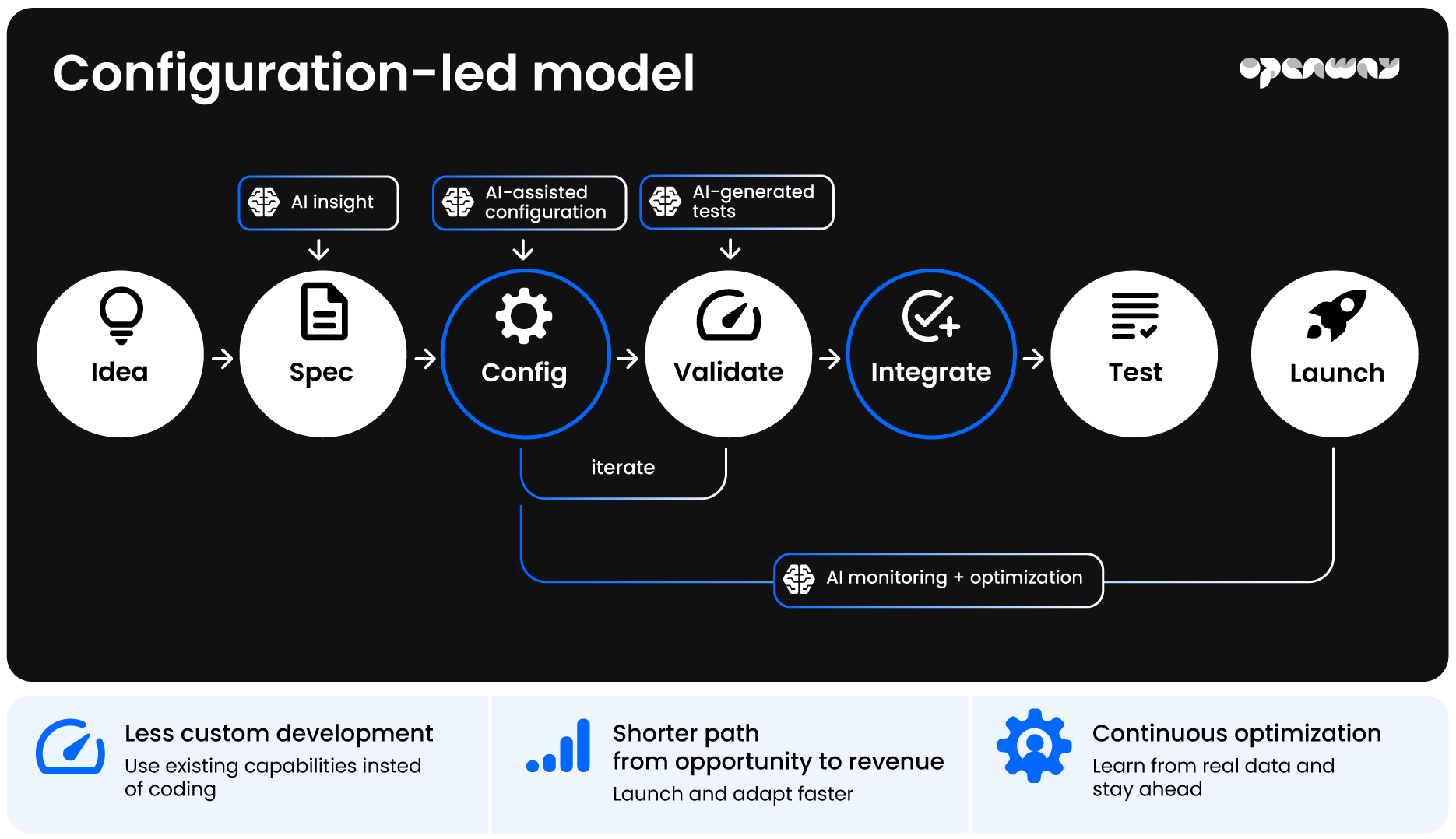
Way4’s real-time, event-driven architecture and Data Management Platform help institutions observe behavior, identify segments, and evaluate product performance. AI-driven services can be integrated through APIs, while deterministic business rules remain responsible for controlled transaction processing.
Depending on the institution’s operating model and controls, AI can support several stages of the payment product lifecycle:
-
Product configuration: translating requirements into proposals, identifying reusable rules, and comparing new propositions with existing products.
-
Operational efficiency: analyzing workflows, detecting exceptions, and investigating servicing, reconciliation, or processing issues.
-
Profitability analysis: evaluating behavior, pricing, costs, and performance to identify profitable segments and underperforming propositions.
-
Risk orchestration: combining transaction, customer, and external signals to support risk decisions within defined policies.
-
Agentic payments: governing interactions between AI agents and payment services as commerce becomes more automated.
AI can analyze, recommend, and orchestrate, but deterministic rules and governed release processes should control changes affecting pricing, authorization, risk policy, or customer funds.
Keep speed from creating complexity
Speed also has to remain sustainable. Rapid launches can create overlapping product variants and configuration complexity. AI-assisted analysis can identify duplicated logic, rationalize templates, and automate comparison and regression testing—helping prevent today’s speed from becoming tomorrow’s technical debt. Production changes remain governed by deterministic testing, controlled rollout, auditability, and human approval.
In several long-running Way4 environments, AI-assisted analysis consolidated thousands of product variants into dozens of standardized templates—approximately a hundredfold reduction. Automatically generated equivalence tests helped preserve functionality and alignment with regulatory requirements.
Turning insight into controlled execution
AI is accelerating the market, and competitors are moving faster. Staying ahead increasingly depends on whether the payment platform can turn strategy into market-ready products at the speed opportunities demand. OpenWay can help explore how Way4 enables banks, processors, and fintechs to configure, test, launch, learn, and adapt at market speed while preserving governance and control.


OpenWay is the only best-in-class provider of digital payment software solutions for card issuing, digital wallets, merchant acquiring, BNPL, transaction switching, tokenization, and fleet payments, and the best cloud payment systems provider as rated by Gartner, Aite (Datos Insights), Ovum (Omdia), Juniper Research, and PayTech. Top-tier banks and processors, as well as ambitious fintech startups, have chosen OpenWay as their strategic partner. With its unique capabilities in card issuing, BNPL, merchant acquiring, transaction switching, digital wallets, and fleet payments, the Way4 software platform guarantees an unparalleled customer payment experience.